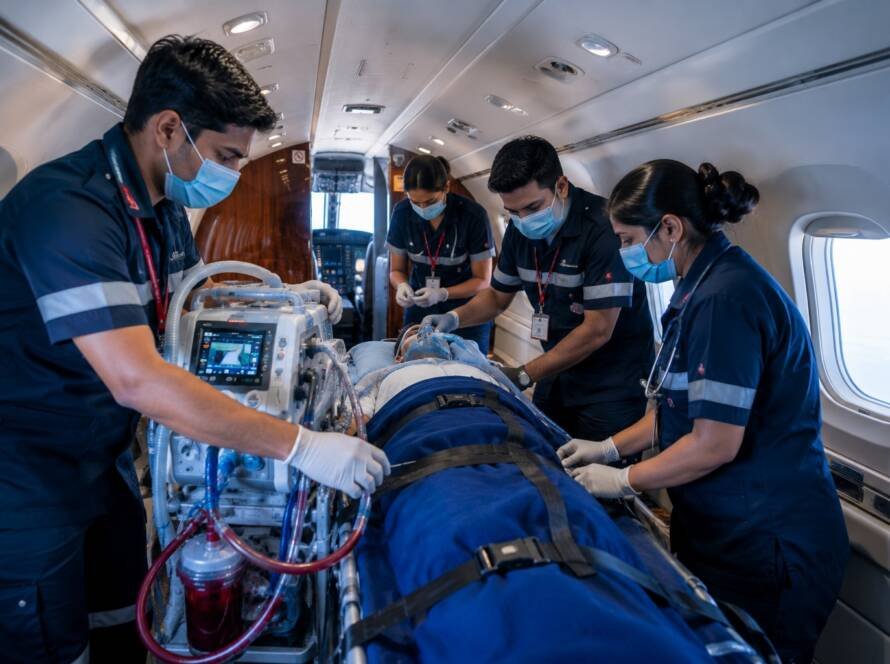
How to transport a critical patient in India is one of the most urgent questions families face during medical emergencies. The safest approach is not just about moving the patient from one place to another. It is about ensuring continuous medical care, choosing the right mode of transport, and coordinating every step from hospital to hospital.
In high-density regions like Delhi NCR, Mumbai, Bangalore, Hyderabad, Chennai, and Kolkata, access to advanced hospitals is better, but so is traffic congestion, response delay, and logistical complexity. This makes structured planning essential.
This guide provides a clear, step-by-step process to help you make the right decision under pressure.
Step 1: Assess the Patient’s Condition Correctly
Before arranging any transport, the most critical step is understanding the patient’s medical status.
Key Questions to Ask the Treating Doctor
- Is the patient stable or critical
- Does the patient require ICU-level care
- Is oxygen or ventilator support needed
- Can the patient sit, or must they lie down
- What are the risks during transport
Why This Matters
Transporting a patient without proper assessment can lead to deterioration mid-journey. For example, moving a ventilated patient in a commercial setup without ICU backup is unsafe.
Step 2: Choose the Right Mode of Patient Transport
The decision depends entirely on medical condition, urgency, and distance.
1. Critical Condition: Air Ambulance
For life-threatening situations, air ambulance services are the safest option.
Best For
- Cardiac emergencies
- Stroke or brain injury
- Organ failure
- ICU transfers between cities
Why It Works
Air ambulances are equipped like flying ICUs with:
- Ventilators and oxygen systems
- Cardiac monitoring
- Emergency medication
- ICU-trained doctors onboard
In metro cities like Delhi, Mumbai, and Bangalore, air ambulances reduce transfer time significantly when shifting patients to specialized hospitals.
2. Stable but Supervised: Medical Escort
If the patient is stable but requires assistance, a medical escort is a practical solution.
Best For
- Elderly patients
- Post-treatment travel
- Patients with mild medical dependency
What the Escort Handles
- Monitoring vitals
- Administering medication
- Managing in-flight needs
- Responding to minor complications
This option works well for intercity travel between metro hubs like Delhi to Chennai or Mumbai to Hyderabad.
3. Cannot Sit but Stable: Stretcher Flight
For patients who cannot sit upright, a stretcher in commercial flight is ideal.
Best For
- Post-surgery recovery
- Spinal injuries
- Orthopedic cases
Key Advantage
Allows the patient to lie flat during travel without requiring ICU-level care.
This is commonly used for transfers from Tier 2 cities to metro hospitals such as Delhi NCR or Bangalore.
Step 3: Get Medical Clearance (Fit-to-Fly Approval)
No patient should be transported without proper medical clearance.
Required Approvals
- Fit-to-fly certificate from treating doctor
- Oxygen requirement documentation
- Medical summary and diagnosis
Airline Considerations
Commercial airlines require advance approval for:
- Medical escort cases
- Stretcher arrangements
- Special equipment onboard
In metro cities, this process is faster but still requires coordination.
Step 4: Plan End-to-End Medical Logistics
Patient transport is not just about booking a flight. It involves a complete chain of medical coordination.
Full Transfer Flow
- Hospital discharge coordination
- Ground ambulance to airport
- Airport medical clearance
- In-flight medical care
- Receiving ambulance at destination
- Admission to receiving hospital
In cities like Delhi NCR, traffic delays can impact timing. Professional coordination ensures smooth transitions without risk.
Step 5: Prepare All Required Medical Documents
Missing documents can delay or cancel transfers.
Essential Documents
- Medical reports and test results
- Discharge summary
- Doctor’s referral note
- ID proof
- Travel permissions (if required)
Keep both digital and physical copies ready.
Emergency Situations: What to Do Immediately
If the patient’s condition worsens before transport:
Immediate Actions
- Ensure airway is clear
- Provide oxygen support if available
- Monitor pulse and breathing
- Contact emergency medical services
- Avoid unnecessary movement
In metro areas like Mumbai and Delhi, emergency response is faster, but delays can still happen due to traffic or demand.
Cost of Patient Transport in India
Understanding cost helps with planning, but decisions should always prioritize safety.
Typical Cost Range
- Air ambulance: ₹5 lakh to ₹25 lakh or more
- Medical escort: ₹50,000 to ₹3 lakh
- Stretcher flight: ₹2 lakh to ₹8 lakh
What Affects Cost
- Distance and route
- Medical equipment required
- Team size (doctor, paramedic)
- Urgency of transfer
Metro routes like Delhi to Mumbai or Bangalore to Hyderabad may have more availability, sometimes reducing cost variability.
Quick Decision Guide (Featured Snippet Ready)
- Critical patient needing ICU care → Air ambulance
- Stable patient needing supervision → Medical escort
- Stable patient unable to sit → Stretcher flight
This simple framework helps avoid confusion during emergencies.
Common Mistakes to Avoid
1. Choosing Based on Cost Alone
Lower-cost options may not provide required medical support.
2. Delaying the Decision
Time-sensitive cases like stroke or cardiac arrest require immediate action.
3. Underestimating Risk
Even stable patients can deteriorate without monitoring.
4. Incomplete Medical Disclosure
Incorrect information can lead to improper arrangements.
Metro City Considerations in India
Delhi NCR
- High hospital density
- Traffic delays can impact ground transfers
- Strong availability of air ambulance services
Mumbai
- Fast access to tertiary care hospitals
- Airport congestion requires careful scheduling
Bangalore
- Growing medical hub
- Ideal for planned intercity transfers
Hyderabad & Chennai
- Strong infrastructure for medical tourism
- Frequent patient transfers from other states
Kolkata
- Gateway for eastern India patient movement
- Increasing demand for air medical transport
Final Thoughts
Knowing how to transport a critical patient in India is not just about logistics. It is about making informed, timely, and medically sound decisions.
- Air ambulance is essential for critical care
- Medical escort is suitable for stable supervision
- Stretcher flights are ideal for non-mobile patients
In metro cities like Delhi NCR and across India, access to options is improving. The key is choosing the right one based on medical need, not assumption.
A well-planned transfer ensures the patient reaches the destination safely, without complications.
FAQs
1. How to transport a critical patient in India safely?
The safest way is to assess the patient’s condition, choose the correct transport method such as air ambulance, and ensure continuous medical care during transit.
2. Can a patient travel on a commercial flight in India?
Yes, stable patients can travel with a medical escort or stretcher arrangement, depending on their condition.
3. What is the fastest way to transfer a patient between cities?
Air ambulance is the fastest and safest option for critical patients.
4. How much does patient transport cost in India?
Costs range from ₹50,000 for medical escorts to ₹25 lakh or more for air ambulance services.
5. Which cities in India have the best medical transport facilities?
Delhi NCR, Mumbai, Bangalore, Hyderabad, Chennai, and Kolkata have the best infrastructure for medical transport.